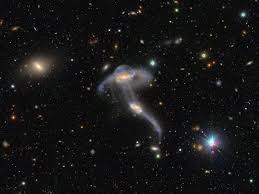
Cosmological jellyfish represent a fascinating phenomenon in modern astrophysics, where galaxies in dense cosmic environments develop striking, tentacle-like features visible in both real observations and advanced simulations. Researchers study these structures to uncover how galaxies interact with their surroundings and evolve over billions of years.
What Are Jellyfish Galaxies?
Jellyfish galaxies earn their name from the long, trailing streams of gas and newly formed stars that extend behind them like tentacles. Astronomers observe these galaxies primarily in galaxy clusters, where they experience extreme environmental forces. The distinctive appearance arises when a galaxy moves rapidly through the hot, dense gas filling the space between cluster members.
Scientists call this process ram pressure stripping. As the galaxy plows forward, the intracluster medium pushes against its interstellar gas like a strong wind. This pressure strips material out of the galaxy’s disk, creating the glowing tails that define the jellyfish shape. Star formation often ignites within these tails under intense conditions, adding bright knots along the streams.
Observations with telescopes such as Hubble have captured stunning examples, including JW100 in the constellation Pegasus and ESO 137-001 in the Norma Cluster. These galaxies lie hundreds of millions to billions of light-years away, yet they reveal processes that shape galaxies across the universe.
The Role of Ram Pressure Stripping in Galaxy Transformation
Ram pressure stripping does more than create visual drama. It removes cold gas that fuels star formation, effectively quenching the galaxy’s ability to create new stars over time. Researchers note that jellyfish galaxies appear more frequently in massive clusters, and they often host active galactic nuclei more than similar galaxies in less dense regions.
This link suggests that gas compression during stripping can trigger bursts of activity around supermassive black holes. In turn, feedback from these black holes influences further galaxy evolution. Simulations and observations confirm that the process occurs across a wide range of galaxy masses and cluster environments.
Introducing the Cosmological Jellyfish Project
The Cosmological Jellyfish project brings citizen scientists together with cutting-edge cosmological simulations to study these galaxies on a massive scale. Led by researchers at the Max Planck Institute for Astronomy, the initiative uses data from the IllustrisTNG simulations—one of the most detailed models of universe evolution available today.
Unlike real-sky observations, these simulations recreate entire cosmic volumes from shortly after the Big Bang to the present. They incorporate gravity, gas dynamics, star formation, and feedback from stars and black holes. By generating thousands of galaxy images, the project asks volunteers to identify which ones resemble jellyfish galaxies.
This citizen-science approach on Zooniverse proves powerful because the human eye excels at spotting subtle asymmetric shapes that algorithms sometimes miss. Launched in 2021, the project has already produced published results thanks to thousands of volunteers.
How the Zooniverse Cosmological Jellyfish Project Works
Participants visit the Zooniverse platform and view centered images of simulated galaxies. A simple tutorial and field guide teach them to recognize jellyfish features, such as extended tails of material trailing from the main stellar body. Volunteers classify each image as jellyfish-like or not.
The project presented nearly 90,000 images from the TNG50 and TNG100 simulations. These cover satellite galaxies spanning stellar masses from 10^8.3 to 10^12.3 solar masses and host halos from small groups to massive clusters. Classifications span redshifts up to z=2, meaning the project examines galaxies as they appeared when the universe was much younger.
After volunteers complete classifications, researchers combine the votes into a reliable score for each galaxy. The team then analyzes the full dataset to answer key questions about when, where, and how long ram pressure stripping acts on galaxies.
Key Findings from Cosmological Jellyfish Research
The project has yielded several important insights. Jellyfish galaxies appear common across nearly all group and cluster environments. Their fraction increases with host halo mass and decreases with satellite galaxy mass. In massive clusters, most systems contain at least one jellyfish galaxy.
Notably, the research extends into previously under-explored regimes: low-mass host halos, galaxies located beyond the virial radius, and high-redshift epochs up to z=2. Jellyfish features already exist when the universe was only about 3 billion years old, showing that environmental stripping operated earlier than many models predicted.
One follow-up study tracked over 500 unique jellyfish galaxies through their history in the TNG50 simulation. It found that ram pressure stripping can persist for billions of years, although most cold gas loss occurs during the first orbit around the host. These results refine our understanding of how galaxies lose their star-forming fuel and transition into “red and dead” ellipticals.
Recent Real-World Discoveries with JWST
While simulations provide context, telescopes deliver direct views. In early 2026, the James Webb Space Telescope spotted the most distant jellyfish galaxy yet observed. Located at redshift z=1.156, this galaxy existed when the universe was roughly 8.5 billion years old. Its clear tentacles demonstrate that harsh cluster environments already shaped galaxies in the early cosmos.
This discovery challenges earlier assumptions that ram pressure stripping required mature, massive clusters. Instead, even proto-clusters in the young universe produced jellyfish features. Combined with Hubble images of nearby examples, these observations confirm that the processes seen in simulations match reality.
Why Studying Cosmological Jellyfish Matters for Galaxy Evolution
Understanding cosmological jellyfish helps astronomers piece together the full story of galaxy formation and transformation. Most galaxies in the local universe reside in groups or clusters, so environmental effects like ram pressure stripping play a major role in their life cycles.
By quantifying how often and how effectively stripping occurs, scientists improve models of star formation history, black hole growth, and the buildup of galaxy clusters. The public data from the Cosmological Jellyfish project remains openly available, enabling further studies by the global research community.
These efforts also highlight the value of citizen science. Volunteers contribute directly to peer-reviewed discoveries, making complex cosmology accessible and collaborative.
How You Can Get Involved in Galaxy Research
Although the original Cosmological Jellyfish classification phase has completed, Zooniverse continues to host similar projects. Anyone with an internet connection can join future galaxy-classification efforts or explore related astronomy initiatives. The team encourages participants to discuss findings on the project Talk forum and stay updated on new publications.
FAQs
What exactly is a cosmological jellyfish?
It refers to jellyfish galaxies identified in cosmological simulations like IllustrisTNG through the Zooniverse project. These galaxies show tentacle-like gas tails caused by ram pressure stripping.
How does ram pressure stripping create jellyfish galaxies?
As a galaxy moves through hot cluster gas, the pressure strips its own gas backward, forming long tails that resemble jellyfish tentacles while triggering star formation.
Why is the Cosmological Jellyfish project important?
It provides the largest systematic catalog of jellyfish galaxies in simulations, revealing their frequency across cosmic time, masses, and environments—insights impossible without citizen science.
Can I still participate in the project?
The main classification phase has finished, but results and data are public. Check Zooniverse for new astronomy projects and read the published papers for ongoing discoveries.
What have recent telescopes revealed about jellyfish galaxies?
JWST recently imaged the most distant example yet, showing these structures existed 8.5 billion years ago and confirming that cluster environments shaped galaxies early in cosmic history.