Introduction
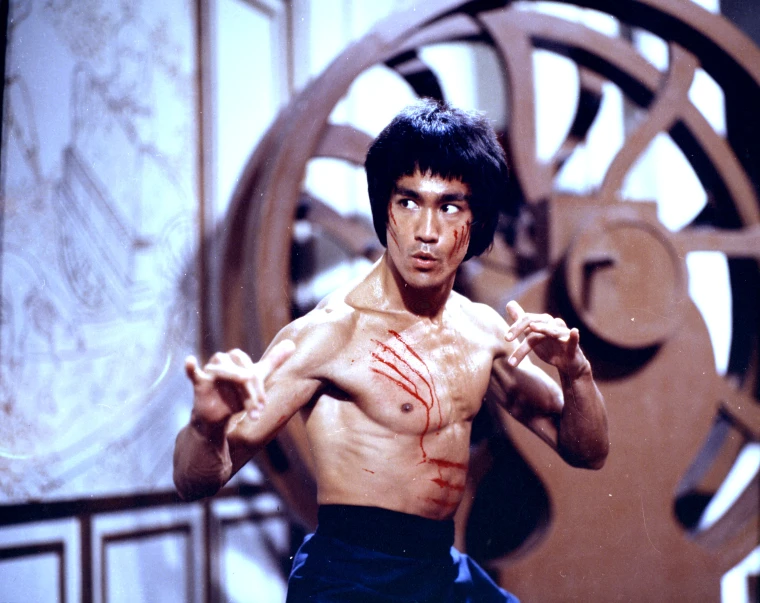
Among the constellation of names that illuminate history’s vast horizon, few blaze as fiercely as Bruce Lee. He was not merely a combatant but an embodiment of philosophy in motion — a visionary whose presence fractured the boundaries between East and West. With lightning grace, magnetic resolve, and intellect as sharp as a blade, Bruce Lee became more than flesh and bone; he became a symbol of human transcendence — of discipline, authenticity, and the relentless evolution of spirit.
Early Life and Background
Family and Heritage
On November 27, 1940, as the world turned uncertainly through the tremors of conflict, Bruce Lee was born in San Francisco during his father’s theatrical voyage. The Lees soon returned to Hong Kong, a city reshaping itself from the ashes of war. His mother’s Eurasian lineage placed him at a crossroad of cultures — a child both of the Orient and the Occident — forging in him an early understanding of duality, identity, and belonging that would later crystallize into philosophy.
Childhood in Hong Kong
Even as a boy, Bruce radiated a kinetic restlessness — a spark untamable. Mischievous and endlessly inquisitive, he often found himself amid street altercations, driven not by malice but by the turbulence of unbridled energy. In the midst of that chaos, he discovered the art that would sculpt his destiny: martial discipline, the crucible through which rebellion would transmute into enlightenment.
The Journey to America
Why Bruce Lee Moved to the U.S.
When his youthful defiance began to shadow his future, Bruce’s parents made a fateful decision — at 18, he was sent across the ocean to the United States. This voyage was not exile but transformation; it became the axis upon which his destiny would turn. America, with its boundless contradictions, became the arena where Bruce would forge his body, his mind, and his legacy.
Life as a Student and Martial Arts Instructor
In Seattle, Bruce immersed himself in academic philosophy at the University of Washington while teaching martial arts to sustain himself. He opened his doors to all — regardless of race, creed, or class — an audacious act in an era fractured by prejudice. Through every movement and lecture, he intertwined intellect with muscle, forging a harmony of mind and motion that defied convention.
Birth of Jeet Kune Do
The Philosophy Behind Jeet Kune Do
From the crucible of thought and rebellion emerged Jeet Kune Do, “The Way of the Intercepting Fist.” It was not a mere martial form but a declaration of freedom — a philosophy that rejected rigidity for the fluidity of life itself. “Be like water,” he proclaimed — shapeless, formless, yet omnipotent — a current that adapts, destroys, and creates anew.
How It Differed from Traditional Martial Arts
Unlike the ossified traditions of classical combat, Jeet Kune Do discarded ornament for essence. It revered function over form, efficiency over ceremony. Lee stripped martial arts to their marrow, unburdening them of dogma until only the raw pulse of truth remained — instinct, immediacy, and expression unrestrained.
Bruce Lee’s Acting Career
Early Roles and Hollywood Struggles
Hollywood, seduced yet suspicious, offered Bruce Lee only fragments of recognition. Though his brilliance radiated in The Green Hornet (1966) as Kato, systemic prejudice curtailed his ascent. He embodied mastery, yet the gatekeepers saw stereotype — an irony that revealed the blindness of an industry enslaved to its own biases.
Rise to Fame in Hong Kong Cinema
Disenchanted, Lee returned to Hong Kong — a home now ready to crown him. With The Big Boss (1971) and Fist of Fury (1972), he ignited a cultural detonation. The screen became his dojo; every punch, a philosophy. His charisma transcended dialogue — it was kinetic poetry, rebellion choreographed into motion.
Iconic Films That Defined His Career
Then came Way of the Dragon (1972) and his magnum opus, Enter the Dragon (1973). The latter, released after his untimely death, immortalized him. It was not just a film — it was scripture. Through it, Bruce Lee etched his legend into the bedrock of global cinema.
Cultural Impact
Breaking Stereotypes in Hollywood
Bruce Lee shattered the cinematic shackles that reduced Asian men to caricature. He redefined the archetype — no longer submissive or silent, but sharp, graceful, indomitable. Through him, Hollywood was forced to confront the brilliance it had long ignored.
Influence on Martial Arts and Pop Culture
His influence rippled through continents — reshaping martial arts, athleticism, and artistry alike. The dojo, the stage, and even the mind became playgrounds of his philosophy. From boxers to philosophers, from dancers to directors, all drew from the current of his thought.
Philosophy and Teachings
“Be Water” – A Life Lesson
“Be water, my friend” — a simple sentence carrying galaxies of wisdom. In its fluid syllables rests the essence of adaptation, patience, and persistence. Water flows softly yet sculpts stone. It yields yet conquers — an eternal metaphor for survival and self-mastery.
Bruce Lee’s Approach to Mind and Body
For Lee, combat was not violence; it was communication. The body was his pen, movement his verse. Every strike was philosophy incarnate — the union of intellect and instinct, where thought and sinew fused into seamless artistry.
Personal Life
Marriage and Family
In 1964, Bruce wedded Linda Emery, a union of minds and spirits. Together, they nurtured two children — Brandon and Shannon — both inheritors of his incandescent flame, bearers of his art and his ideology.
Relationship with His Students and Friends
Those who stood beside him recall his laughter, generosity, and humility. He was a mentor not of fists, but of consciousness — urging his students to confront themselves before confronting any adversary.
The Mysterious Death of Bruce Lee
Events Leading to His Passing
On July 20, 1973, at only 32, Bruce Lee’s heart surrendered in Hong Kong. The official verdict — cerebral edema — could not contain the enormity of the loss. The world fell silent, mourning not only the man but the myth he had become.
The Theories and Controversies
His death, shrouded in conjecture, gave rise to endless theories — yet amidst speculation, one truth endures: his essence remains untethered. Bruce Lee became eternal, his energy diffused into the very culture he helped create.
Bruce Lee’s Legacy
Continuing Influence on Modern Cinema
Modern action cinema breathes his DNA. From Jackie Chan’s acrobatics to Keanu Reeves’s discipline, his imprint endures. He injected intellect into every movement, turning fight scenes into philosophical dialogues between will and chaos.
Martial Arts Schools and Followers
His disciples now span every continent. The ethos of Jeet Kune Do — freedom within structure, self within system — lives on. In every fighter seeking truth rather than trophies, Bruce Lee’s spirit awakens anew.
Bruce Lee in Popular Culture
Tributes and Biopics
His legend reverberates through tributes like Dragon: The Bruce Lee Story (1993) and Be Water (2020). These works do not merely recall his life; they reignite his message — a manifesto of motion and meaning.
Influence on Video Games and Comics
From Street Fighter’s Fei Long to Mortal Kombat’s Liu Kang, his visage persists — eternally reimagined in pixels and panels, a spectral teacher guiding generations through art and action alike.
Bruce Lee’s Fitness Regimen
Diet and Training Secrets
Bruce’s diet was precision incarnate — vibrant with natural sustenance, devoid of artificiality. His training was ritual — an alchemy of strength, endurance, and elasticity. His body was no mere vessel; it was a sculpture of vitality and willpower.
The Science Behind His Strength
His regimen fused science with instinct — explosive motion, core equilibrium, and neural command. His physique was engineered artistry — power in motion, discipline embodied.
Life Lessons from Bruce Lee
Discipline and Focus
Lee’s devotion bordered on spiritual. To him, mastery was not a gift but a covenant with effort. Each repetition was prayer, each failure a stepping stone toward sublimity.
Overcoming Barriers and Fear
He confronted derision, discrimination, and denial — and transmuted them into momentum. His life remains a hymn to resilience, proof that conviction carves through constraint.
Quotes That Define Bruce Lee
Motivational Sayings
“Knowing is not enough; we must apply. Willing is not enough; we must do.”
“The successful warrior is the average man, with laser-like focus.”
Philosophical Insights
“Absorb what is useful, discard what is not, add what is uniquely your own.”
“Be happy, but never satisfied.”
Conclusion
Bruce Lee was not confined by gravity nor genre — he was philosophy incarnate. A thinker, fighter, and poet of existence who united mind, body, and culture into one seamless rhythm. His words still echo across generations: true strength is the stillness within motion, and like water, the spirit must forever flow.
FAQs
- What martial art did Bruce Lee create?
He conceived Jeet Kune Do, a fluid, adaptive form grounded in freedom and functionality. - What was Bruce Lee’s most famous movie?
Enter the Dragon (1973) remains his crowning cinematic triumph. - How did Bruce Lee die?
He passed at 32 from cerebral edema — a mystery still enshrouded in speculation. - Did Bruce Lee have children?
Yes — Brandon and Shannon Lee, who continue to uphold his legacy. - What is Bruce Lee’s most famous quote?
“Be water, my friend.” — a timeless reflection of adaptability and inner harmony.

One thought on “Bruce Lee: from martial artist to Hollywood star”