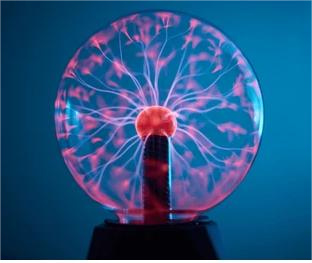
The plasma ball captivates imaginations with its mesmerizing display of colorful lightning bolts dancing inside a glass sphere. This intriguing device, often found in science museums or as a novelty item, demonstrates fundamental principles of physics in an accessible way. Invented over a century ago, the plasma ball combines high-voltage electricity with noble gases to create plasma, the fourth state of matter. In this comprehensive guide, we’ll explore its history, inner workings, exciting experiments, safety considerations, and practical applications, all while highlighting why it remains a favourite for educators and enthusiasts alike.
What Is a Plasma Ball?
A plasma ball is essentially a clear glass globe filled with a mixture of low-pressure noble gases, such as neon, argon, krypton, and xenon. At its center sits a high-voltage electrode, which generates an alternating current that ionizes the gases, turning them into plasma. This ionization process causes the gases to glow and form filament-like streams of light that extend from the center to the outer glass wall.
These filaments appear as vibrant, branching beams in shades of purple, blue, pink, and red, depending on the gas mixture. When you touch the glass, the filaments are drawn toward your hand, creating an interactive experience. Unlike regular light bulbs, plasma balls operate on radio-frequency energy, making them a safe yet thrilling way to observe electrical phenomena up close.
Plasma balls come in various sizes, from small desktop versions to larger ones used in educational settings. They are sometimes called plasma globes or plasma lamps, terms that emphasize their spherical shape and illuminating effects. This device not only serves as decor but also as a tool for teaching about electricity, states of matter, and electromagnetic fields.
The History of the Plasma Ball
The origins of the plasma ball trace back to the late 19th century. Nikola Tesla, the renowned inventor and electrical engineer, first experimented with high-frequency currents and gas discharge tubes in the 1890s. He patented an “incandescent electric light” in 1894 that used a Tesla coil to excite gases in evacuated tubes, producing luminous effects. Tesla’s work laid the groundwork for understanding plasma and high-voltage applications.
However, the modern plasma ball was developed in the 1970s by MIT student Bill Parker and artist James Falk. Parker created an early prototype as part of his studies, using advanced gas mixtures that weren’t available to Tesla. These mixtures allowed for more vivid colors and dynamic patterns. By the 1980s, plasma balls surged in popularity as novelty items, praised for their artistic and scientific appeal. Science fiction writer Jerry Pournelle even described one in 1984 as a “magnificent thing” that blended art and technology.
Over the decades, plasma balls have evolved from experimental devices to common educational tools. Today, they are manufactured with improved safety features and used in classrooms worldwide to illustrate complex concepts like ionization and electric fields. Their enduring legacy reflects humanity’s fascination with harnessing electricity in visually stunning ways.
How Does a Plasma Ball Work?
At its core, a plasma ball functions like a miniature Tesla coil. The central electrode receives high-voltage, high-frequency alternating current—typically around 2,000 to 5,000 volts at 35 kilohertz—from a built-in transformer and oscillator. This energy radiates outward, ionizing the noble gases inside the globe.
The Science Explained
Ionization occurs when the electric field strips electrons from gas atoms, creating a plasma—a hot, conductive mixture of ions and free electrons. The plasma filaments form as these charged particles move toward the glass wall, which acts as an insulator. The colors arise from excited electrons recombining with ions, releasing photons at specific wavelengths: neon produces red, argon enables thin filaments, and xenon adds blue hues.
A control knob often adjusts the voltage. Lower settings create a single, stable tendril, while higher power generates multiple filaments that repel each other due to like charges. Touching the globe polarizes your body, attracting filaments because it offers a path of lower resistance to ground. Heated plasma rises due to buoyancy, causing the streams to wiggle and dance.
This process also involves capacitive coupling, where the electric field extends beyond the glass, allowing interactions with nearby objects. The partial vacuum inside—lower pressure than atmospheric—facilitates easier ionization, making the display more dramatic. In essence, the plasma ball transforms invisible electrical energy into a visible spectacle, bridging everyday curiosity with advanced physic
Fun Experiments with a Plasma Ball
Plasma balls aren’t just for watching—they’re perfect for hands-on experiments that reveal electrical principles. Always perform these in a safe environment, with adult supervision if needed.
Basic Demonstrations
Start simple: Place your hand on the globe in a dark room. Watch as filaments converge on your touch point, brightening and thinning due to the electric field’s focus. This shows how your body conducts electricity better than air.
Next, bring a fluorescent light tube close to the plasma ball without touching it. The tube glows faintly as the radio-frequency energy ionizes its mercury vapor, converting ultraviolet light to visible glow. This demonstrates wireless energy transfer and plasma conductivity.
For a spark test, place a coin on the globe and touch it with another coin (not your finger). A small spark jumps, illustrating electric field breakdown similar to lightning.
Advanced Experiments
Stand on an insulated surface like a wooden stool, touch the plasma ball, and hold a fluorescent tube. The tube lights up brightly as electrons flow through your body without grounding. Release the tube carefully—it stays lit briefly, showing charge accumulation.
Explore spectra by viewing the filaments through a diffraction grating. You’ll see distinct color lines corresponding to the gases’ emission spectra, teaching about atomic physics.
Another demo: Use the plasma ball to power a small cathode ray tube, observing electron beams deflected by magnets. This highlights high-voltage applications in older technologies like TVs.
These experiments make abstract concepts tangible, fostering a deeper appreciation for science.
Safety Tips for Using a Plasma Ball
While plasma balls are designed for safety, precautions ensure enjoyable use. The high-voltage inside can cause mild shocks if the glass cracks, so handle gently and avoid dropping. Radio-frequency emissions may interfere with nearby electronics like laptops or Wi-Fi—keep them at a distance.
Ozone production, though minimal (0.01-0.1 ppm), can cause headaches or irritation in enclosed spaces; use in well-ventilated areas. Never touch the globe with wet hands or near flammable materials, as arcs from capacitive coupling could ignite them. In rare cases, sparks have caused incidents, like a 2022 museum event involving hand sanitizer.
Unplug when not in use, and supervise children to prevent mishandling. Following these tips keeps the focus on fun rather than risks.
Applications and Uses of Plasma Balls
Beyond toys, plasma balls serve educational purposes in schools, demonstrating plasma as the universe’s most common state of matter—found in stars and lightning. They’re used in physics labs for studying electric fields, convection, and spectra.
As nightlights, smaller versions provide soothing ambient glow. In art installations, they create dynamic visuals, pulsing to music via sound-sensitive models. Some therapeutic applications explore their calming effects, though not medically proven.
Commercially, plasma balls appear in novelty shops and online retailers like Amazon or Walmart, often bundled with STEM kits. Their versatility makes them a staple for sparking scientific interest.
FAQs
What is a plasma ball?
A plasma ball is a glass sphere containing noble gases and a central electrode that creates glowing plasma filaments when powered.
How does a plasma ball work?
It uses high-voltage, high-frequency current to ionize gases, forming plasma streams that glow and respond to touch.
Is a plasma ball safe to touch?
Yes, the glass insulates you, but avoid if cracked, and use in ventilated areas to minimize ozone exposure.
Can I make a plasma ball at home?
DIY versions are possible with Tesla coil kits, but require electrical expertise and safety gear to avoid hazards.
Why do plasma balls interfere with electronics?
They emit radio-frequency energy, which can disrupt signals in devices like phones or computers.