The Four Agreements: Guide to Freedom & Growth In a fast-paced world filled with stress and self-doubt, The Four Agreements offers a beacon of clarity. Don Miguel Ruiz’s best selling book draws from ancient Toltec wisdom to reveal four simple yet profound principles that foster personal freedom. Readers embrace The Four Agreements as a roadmap for breaking free from limiting beliefs, enhancing relationships, and achieving true happiness. The Four Agreements: Guide to Freedom & Growth This guide explores the book’s core teachings, their practical applications, and why they remain essential for modern self-improvement.
Published in 1997, The Four Agreements has sold over 15 million copies worldwide and topped the New York Times bestseller list for years.The Four Agreements: Guide to Freedom & Growth Ruiz, a former surgeon turned spiritual teacher, blends indigenous Mexican heritage with universal truths to address the “domestication” of humans—those ingrained societal rules that breed fear and suffering. By adopting these agreements, you rewrite your internal story, paving the way for authentic living.The Four Agreements: Guide to Freedom & Growth Whether you’re new to personal development or revisiting Toltec wisdom, this book delivers actionable insights for emotional healing and mindful growth.
Who Is Don Miguel Ruiz? The Man Behind Toltec Wisdom
Don Miguel Ruiz grew up in a family of healers in rural Mexico, immersed in ancient traditions. A near-fatal car accident in his youth shattered his materialistic worldview, leading him to study under his mother, a Toltec nagual (shaman). He trained as a surgeon but ultimately chose the path of spiritual guidance, authoring multiple books that fuse Toltec philosophy with contemporary psychology.
Toltec wisdom, as Ruiz interprets it, isn’t tied to a specific race but to a society of artists and scientists who preserved esoteric knowledge from ancient seers. Central to this is the idea of “mitote”—the fog of thousands of voices in our minds, echoing societal conditioning. Ruiz’s teachings empower readers to pierce this fog, reclaiming personal power. His work has influenced figures like Oprah Winfrey, who praised it for its life-changing simplicity. Today, Ruiz’s legacy endures through workshops, online courses, and a global community dedicated to Toltec practices.
The Dream of the Planet: Understanding Human Domestication
Ruiz opens The Four Agreements with a metaphor: humanity lives in a collective “dream of the planet,” a shared illusion shaped by culture, religion, and family. From childhood, we undergo “domestication,” like animals trained with rewards and punishments. Parents, teachers, and media instill beliefs— “be perfect,” “don’t feel,” “don’t trust”—that form our “Book of Law,” an internal judge that enforces self-criticism.
This process creates hell on earth: repeated mental punishments for perceived flaws. Ruiz argues that awareness is the first step. By questioning these old agreements, you dismantle the lies fueling anxiety and conflict. Top blogs like Thought Canvas emphasize how this awareness sparks profound self-improvement, turning victims of circumstance into architects of their reality.
Breaking Down the Four Agreements: Core Principles for Transformation
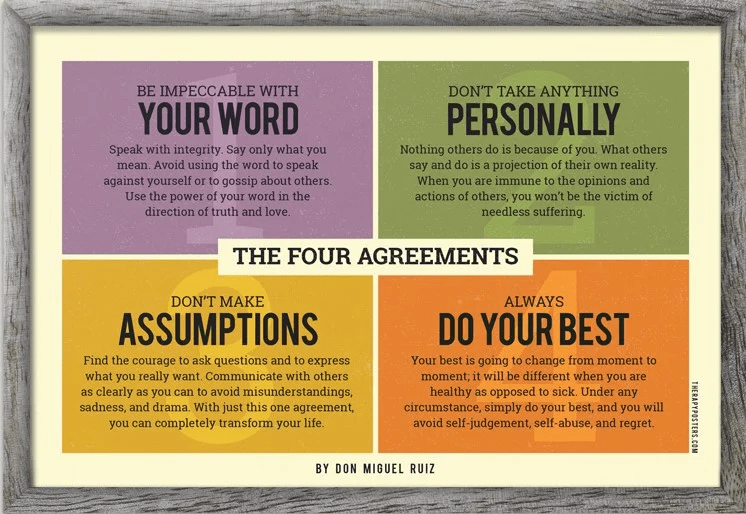
At the heart of Ruiz’s philosophy lie the four agreements themselves—straightforward codes that, when practiced, dissolve emotional poison and cultivate joy. Each builds on the last, forming a holistic framework for daily life.
First Agreement: Be Impeccable with Your Word
Words hold immense power; they create reality or sow destruction. Ruiz defines “impeccable” as “without sin,” where sin means actions against yourself. Speak truth, express love, and avoid gossip or self-deprecation. This agreement demands responsibility: your words shape your destiny.
In practice, impeccability means affirming strengths during challenges. A Medium post from Raluca Barna shares how this principle shifted her from negative self-talk to manifesting opportunities, boosting career confidence. Avoid passive pitfalls like “I might fail” (passive voice invites doubt); instead, declare actively, “I succeed through effort.” This fosters emotional healing, as impeccable speech builds trust in relationships and self-worth.
Second Agreement: Don’t Take Anything Personally
Personal importance—the belief that everything revolves around you—fuels suffering. Others’ actions reflect their own dreams, not your value. A rude comment? It’s their poison, not yours. By releasing this, you gain immunity to criticism.
Ruiz illustrates with compliments too: don’t inflate egos; accept them humbly. Blogs like 50 is the New 50 recount real-life wins, such as navigating family drama without resentment, leading to deeper connections. In professional settings, this principle prevents workplace burnout. Leaders who embody it inspire teams, as noted in krconnect.blog’s analysis of conflict resolution.
Third Agreement: Don’t Make Assumptions
Assumptions breed misunderstandings; they stem from fear and misinformation. Ruiz urges clear communication: ask questions, express needs, and clarify intentions. This eliminates drama and aligns actions with truth.
Imagine assuming a partner’s silence means anger—devastating, yet avoidable. Jari Roomer’s Peak Productivity article highlights how ditching assumptions streamlined his productivity, freeing mental energy for creativity. Active dialogue replaces vague worries: “What do you need?” transforms vague fears into collaborative solutions, enhancing relationships and mindfulness.
Fourth Agreement: Always Do Your Best
Your “best” varies—tired days differ from energized ones—but effort absolves guilt. This agreement ties the others together, making them habits without perfectionism. Ruiz warns against self-judgment; focus on intention.
Dongming Lau’s Thought Canvas post applies this to fitness goals: consistent effort, not flawless workouts, yields sustainable progress. In self-improvement journeys, it prevents burnout, promoting balance. Teams thrive when members give their all, as Ruiz’s wisdom underscores in leadership contexts.
Applying The Four Agreements: Real-Life Impact on Relationships and Happiness
Integrating these principles revolutionizes daily interactions. In relationships, impeccability builds honesty, while not taking things personally diffuses arguments. Couples report renewed intimacy, as assumptions fade into open talks. For happiness, the agreements dismantle the “victim” mindset, replacing it with empowerment. Indigo Terra’s Medium reflection details escaping toxic cycles, fostering authentic joy.
Professionally, they enhance leadership. Ruiz’s code encourages ethical communication and resilience, vital in high-stakes environments. A BusinessBalls.com review positions it as a template for workplace harmony. Challenges arise—old habits resist change—but persistence pays off. Start small: journal one agreement daily. Over time, Toltec wisdom cultivates inner peace, proving its relevance amid modern chaos.
Critics, like those in Beacon Apologetics, question its New Age leanings, favoring biblical alternatives. Yet, even skeptics acknowledge the agreements’ practical value for ethical living. As David Mokotoff notes, they’re “even more relevant today” for navigating division.
Why The Four Agreements Endures: Legacy and Modern Relevance
The Four Agreements transcends trends, offering timeless tools for personal growth. Its brevity—under 150 pages—belies its depth, inspiring rereads and adaptations. In an era of social media echo chambers, these principles counter misinformation and polarization.
For self-improvement enthusiasts, it pairs well with mindfulness practices. Ruiz’s follow-up works, like The Mastery of Love, expand on relational dynamics. Global translations and courses amplify its reach, with millions applying Toltec wisdom for emotional healing.
Ultimately, Ruiz reminds us: heaven is a state of mind. By living these agreements, you craft your paradise—one word, one assumption, one best effort at a time. Embrace The Four Agreements today; your transformed life awaits.
Frequently Asked Questions (FAQs)
What are the four agreements in Don Miguel Ruiz’s book?
The four agreements are: Be impeccable with your word, Don’t take anything personally, Don’t make assumptions, and Always do your best. They form a code for personal freedom based on Toltec wisdom.
How can The Four Agreements improve relationships?
By promoting honest communication and reducing assumptions, the agreements foster trust and empathy. Readers report fewer conflicts and deeper connections when applying them daily.
Is The Four Agreements suitable for beginners in self-improvement?
Yes, its simple language and short length make it accessible. Start with one agreement to build habits gradually for lasting emotional healing.
What’s the main theme of Toltec wisdom in the book?
Toltec wisdom emphasizes breaking free from societal “domestication” to live authentically, replacing fear-based beliefs with love and truth.
Can The Four Agreements help with anxiety or stress?
Absolutely. Not taking things personally and avoiding assumptions reduce mental chatter, leading to greater inner peace and happiness.